

By Kunal Chan Mehta, PR Manager and Editor, and Jiahuan (Henry) Qian FRSA, BNU Trainee Programme Leader | Article Date: 30th April 2026
Artificial intelligence (AI) tools are a normal part of FSB student life. These can help you proofread, explore, brainstorm, organise ideas and learn more efficiently. However, it is important to use AI with integrity to support your learning rather than replace it.
At FSB, we embrace new technologies and want you to feel confident about the positive ways AI technology can support your learning. We value experimentation in teaching and learning and want everyone to feel inspired by AI. This article demonstrates how you can safeguard your learning by using our AI with Integrity (I), Honesty (H) and Transparency (T) model below. We also draw attention to FSB’s Academic Integrity Guidelines, available via FSB’s internal portal, which should be read in conjunction with this article.
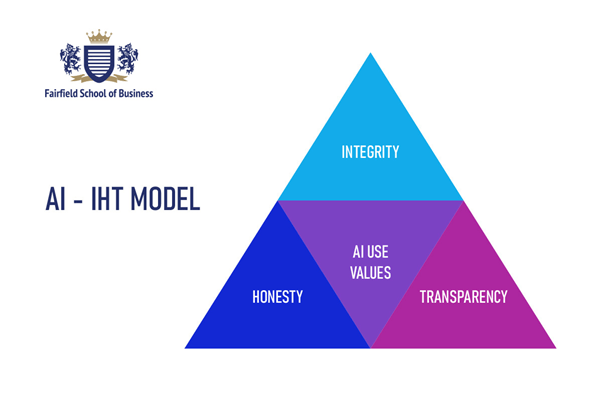
This guide explains what these values (a) mean, (b) why they matter and (c) how you can use AI responsibly in your studies at FSB using additional figures and models (see figures 2, 3 and 4 below).
IHT – What FSB Expects
FSB expects students to be honest and transparent about how AI has contributed to their work. AI may serve as a helpful assistant, but your submitted work must remain your own. AI can assist your learning, but it cannot replace your thinking.
Use IHT to guide your AI integrity:
Integrity (I)
Integrity is about doing your work in a way that reflects your genuine learning, effort and understanding. It is taking accountability for your work. Over-reliance on AI can weaken your ability to think independently, limiting the development of the analytical and problem-solving skills expected of FSB students.
1. Focus on understanding – not just completing tasks
Use AI to strengthen your understanding, not as a shortcut to answers. When used critically, AI can support reasoning and discussion; when used uncritically, it can weaken genuine learning.
2. Keep asking questions until concepts are clear
Deeper learning often comes from moving beyond the first response. Ask follow-up questions to test assumptions, clarify meanings and explore alternative perspectives.
3. Use Generative AI (GenAI) to explore topics more deeply
AI is most useful when it helps you explore a topic rather than merely retrieve information. Open-ended prompts and role-based questioning can help you examine complex issues from different angles.
Example: If you are studying marketing, you could ask AI to explain the differences between segmentation, targeting and positioning in simple language, then ask it to provide a real-world example, and finally ask it to compare two different company approaches. You can also ask AI to take on different roles to help with your learning. For instance, you could ask it to act as a tutor, an examiner or a critical peer. AI should serve as a tool for deepening understanding rather than providing a finished answer.
Similar strategies can be used across disciplines, for example, by asking AI to explain a theory, compare interpretations, test your reasoning or generate questions for revision.
4. Use creative approaches, such as brainstorming and role play, to build insight
Creative AI engagement – like brainstorming, role-playing viewpoints or “what if?” scenarios – can make your learning active rather than passive. Such approaches can reveal hidden angles and encourage empathy with different perspectives. They can also broaden the generation of ideas beyond simple answers.
5. Avoid relying on AI for all your research
GenAI can augment but not replace solid research skills. Judicious users critically verify AI output against trusted sources and integrate external knowledge, avoiding over-reliance that can weaken independent judgment and intellectual autonomy.
6. Don’t limit yourself to a few quick prompts
One-shot prompts often produce limited answers. Better results usually come from revising your prompts, adding context and testing different perspectives.
Tip: A useful question to ask yourself is: “If my lecturer asks me to explain how I produced this work, could I clearly describe what I did myself and what AI helped me with?” If the answer is “no”, then you may need to rethink how you are using AI.
Remember, you remain responsible for the accuracy, quality and integrity of anything you submit.
Honesty (H)
Honesty means not pretending that AI-generated content is your own work. If AI has influenced your work, you should explain this when submitting it. For example, you could include a short note like:
I used [name of AI tool] to support early idea generation, clarify concepts and improve the presentation of my writing. I reviewed and edited all outputs critically, checked information against appropriate sources, and take full responsibility for the final submitted work.
Or
I used [name of AI tool] to assist with structuring my ideas, refining academic language and identifying areas for further research. All content generated was carefully reviewed and integrated into my own work. I ensured accuracy by consulting relevant academic sources and taking full responsibility for the final submission.
This shows that you used AI honestly and took ownership of your work.
1. Submit material you can explain in your own words
Submitting work without understanding it undermines learning and can lead to academic or professional mistakes. Deep understanding ensures you can explain and build on your work confidently.
2. Don’t copy AI-generated text directly into assessed work
Directly copying AI-generated text risks errors and superficial learning. Reflecting on and editing your outputs encourages critical evaluation and reinforces understanding.
3. Don’t allow AI to replace your own judgment, analysis or voice
AI should assist, not replace, your effort. Relying entirely on it can reduce your creativity and diminish your sense of ownership of your work. Your own voice is essential. AI can help clarify or explore ideas but should not substitute for your original thinking or judgment.
Tip: Presenting AI-generated content as your own may constitute academic misconduct and could lead to formal investigation under FSB’s AI Integrity Guidelines and Academic Misconduct Policy and Procedure.
Always check with your tutor or lecturer if your course has specific instructions for how to declare AI use.
Transparency (T)
Transparency means being open and critical about how you used AI and being able to explain that use clearly. You should be able to distinguish between what AI contributed and what you produced yourself. Transparency is about careful checking, as AI outputs can be inaccurate, incomplete or misleading.
1. Check facts against reliable academic journals and book sources
Always verify AI-generated information using credible and peer-reviewed academic sources. This ensures accuracy and prevents the spread of false information.
2. Don’t accept information without questioning it
AI can provide plausible but incorrect or incomplete answers. So always question assumptions and outputs to build a deeper understanding.
3. Clarify uncertainty before using AI output
If an AI response is unclear, incomplete or ambiguous, do not use it until you have checked and understood it.
4. Seek different perspectives to avoid bias
AI outputs may reflect biases in its training data, so exploring multiple viewpoints, even across different AI models, ensures a more balanced and critical understanding.
5. Use AI for legitimate support
AI may help with grammar, structure or summarising information, but it must never be used to invent information, create false references or disguise authorship.
Tip: AI systems can generate plausible but incorrect information, including fabricated references, data or case studies. These errors may not be immediately obvious and must always be checked against reliable academic sources.
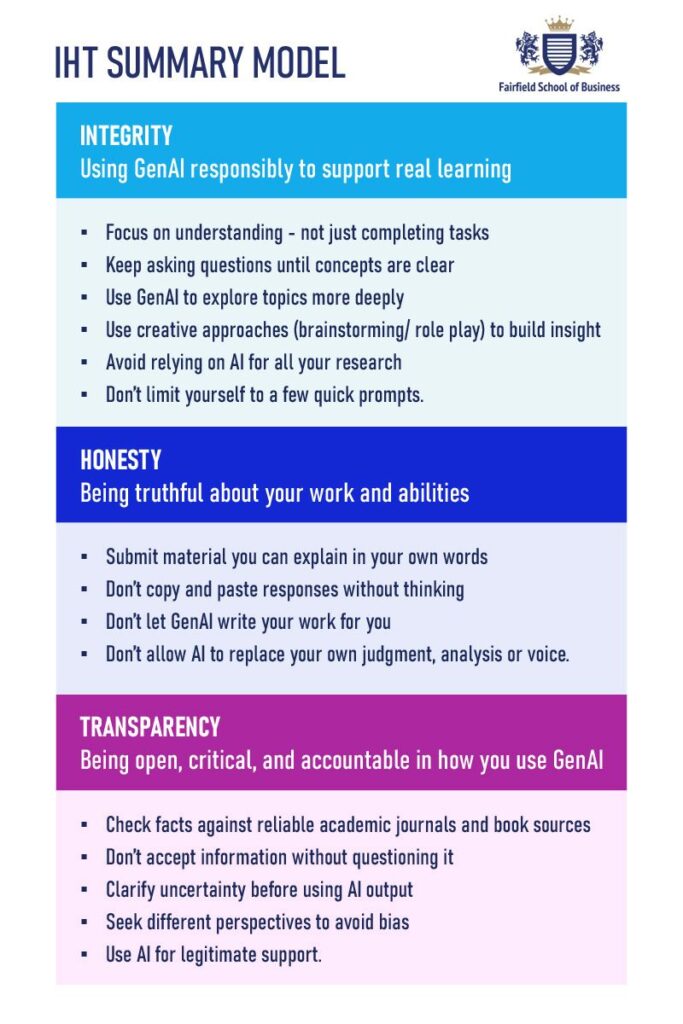
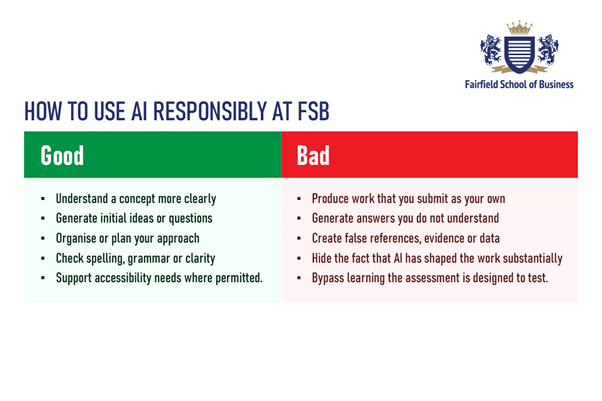
Figure 4: FSB’s AI Use Traffic Light System
Following the traffic light system below can ensure you get the benefits of using AI without risking your grades or learning:
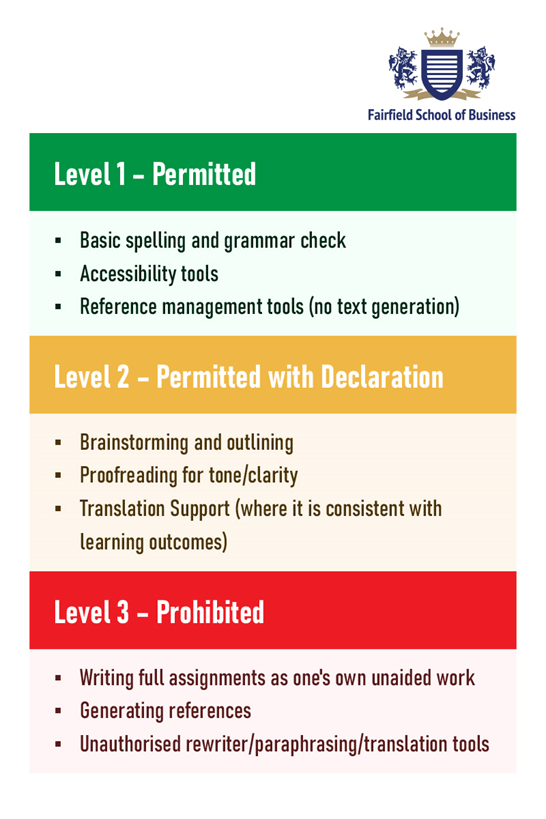
Acceptable vs Unacceptable Use of AI
AI may be appropriate when:
• Asking AI to suggest possible essay discussion questions or topic areas before you decide your own focus.
• Asking AI to generate practice quiz questions, flashcards or short summaries to test your understanding of a topic.
• Asking AI to challenge your argument, suggest counterarguments or identify gaps in your reasoning so that you can improve your own work.
AI is not appropriate when:
• Asking AI to write your essay, report, reflection, case study or discussion post and then submitting it as your own work.
• Using AI-generated references, quotations, statistics, case examples or sources without checking whether they are real and accurate.
• Copying AI-generated explanations or analysis into an assignment when you would not be able to explain them to your lecturer.
Source: FSB Academic Integrity Guidelines.
Always remember, AI may support your learning, but it must not replace the learning your assessment is meant to demonstrate. Always follow the assessment brief and declare AI use where required.
FSB AI Use Checklist – Before Submitting Your Work
Before submitting your work, take a moment to reflect on this checklist. Misuse of AI may compromise not only your academic integrity, but also the development of independent thinking, subject knowledge and professional skills expected at degree level.
☐ I can explain all parts of this work in my own words.
☐ I have declared my AI use where required.
☐ I have checked any AI-generated claims, examples or references.
☐ My submission reflects my own judgement, analysis and academic voice.
Integrity (I)
☐ I have distinguished my own ideas from AI-generated suggestions.
☐ I have used AI to support learning and not to replace my thinking.
☐ I have critically evaluated any AI output before including it in my work.
☐ I have verified facts and examples against credible academic sources.
Honesty (H)
☐ I have declared any AI tools I used in my assignment.
☐ I understand all parts of the work and can explain them in my own words.
☐ I have not copied and pasted AI-generated text.
☐ I have followed any course-specific instructions for AI disclosure.
Transparency (T)
☐ I can clearly explain what AI contributed and what I created myself.
☐ I have checked facts against reliable sources.
☐ I have documented key prompts or outputs if needed for reference.
☐ I have not used AI to mislead.
Why this guide matters
FSB values independent thinking, clear communication and responsible academic practice. Honest and transparent use of AI helps you develop habits that will matter not only in your studies but also in professional contexts.
If you are unsure whether a particular use of AI is acceptable, speak to your lecturer, PAT or Academic Support Team, as expectations may differ across modules and assignments. In general, questions about permitted AI use should be discussed before submission.
Students should always apply the guidance of their tutors and/or lecturers for each submission of work.
Declaration: An AI tool, ChatGPT, was used to review grammar and clarity. All content, ideas and analysis are those of the authors. Diagrams and figures are original concepts developed by the authors and were created using Adobe software by Eugene Wong.
For questions or further information on this guide, please email the authors via kunal.mehta@fairfield.ac and henry.qian@fairfield.ac.
References
Mehta, K., 2026. The Student Voice Within: Artificial Intelligence and the Recalibration of Wisdom. FSB Blogs. Available at: https://fsb.ac.uk/the-student-voice-within-artificial-intelligence-and-the-recalibration-of-wisdom/ [accessed 30 April 2026].
Fairfield School of Business, 2026. Artificial Intelligence (AI) and Academic Integrity Guidelines. Version 1.0. Internal document. Accessed via FSB Connect: https://portal.fairfield.ac/login/index.php.
We trust you found FSB News engaging and informative. Step into our academic realm and unlock boundless avenues for personal and professional development at www.fsb.ac.uk/courses or through admissions@fairfield.ac. Embrace the possibilities at FSB and commence your transformative educational journey today.