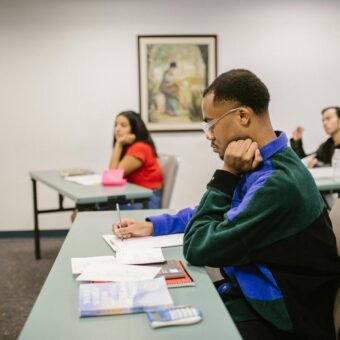

Amid the post-AI recalibration of cognition, a positive narrative about discipline is emerging across FSB. Image: Created by the author using Adobe Creative tools and Adobe Firefly. Image licensed to FSB.
By Kunal Chan Mehta, PR Manager and Editor of FSB Focus | Article Date: 10/03/2026
There was once a pause in academic thought – a moment between question and conclusion where uncertainty was endured. It was here that our intellect was strengthened. Arguments were not downloaded – they were developed. Conviction was not generated – it was earned. Today, generative artificial intelligence is compressing that space.
AI has entered academia with extraordinary velocity, reshaping not simply how students access information but how thought itself unfolds. Where earlier generations grappled with ambiguity, contemporary students can, in mere seconds, summon specific structure, synthesis, and rhetorical fluency.
The question is therefore no longer whether students use AI. They do. The more consequential question is what becomes of intellectual identity when analysis and articulation feel instantly accessible. If such synthesis can be summoned in seconds, where does judgement reside?
This is no abstract philosophical debate. It is now a lived academic reality – including within FSB – and our students themselves are among its most perceptive commentators (you will see FSB student voices later in this article).
Every technological epoch has reshaped the architecture of thought. Think about it. Calculators altered mental arithmetic. Search engines transformed information retrieval. Generative AI, however, operates at a different level. It does not merely retrieve information; it organises, synthesises and concludes, producing fluent arguments with remarkable ease.
The result is a form of cognitive acceleration – an environment where reasoning can appear complete before reflection has fully matured.
The Illusion of Certainty
“We have already entered an era in which artificial certainty can masquerade as wisdom,” says Georgiana Duma, SU President at FSB. “But AI has also given students a new kind of confidence – the algorithm as adviser, analyst and even confidant. The critical distinction is knowing how to use AI and not surrender to it.”
Her observation captures a defining paradox. Academic authority, once accumulated gradually through reading, revision and disciplined effort, can now be modelled almost instantly.
Asiya Majid, a Business Management with Foundation Year student at FSB Sheffield, sharpens the insight: “The risk is not necessarily that AI is wrong – but that it feels right too quickly. Speed can simulate certainty. Fluency can mimic truth.”
Human cognition instinctively associates clarity with correctness and confidence with competence (Kosmyna et al., 2025). Generative systems replicate these signals effortlessly. The challenge, therefore, is rarely identifying obvious errors. It is recognising when articulation subtly reshapes original thinking.
Students I interviewed describe beginning with a tentative interpretation, only to have it recalibrated after encountering AI-generated language. The shift is often almost invisible. Tone alters, emphasis changes and the architecture of thought can quietly migrate away from its point of origin.
Authorship Anxiety
For many students, AI is neither oracle nor adversary. It is an instrument – formidable, efficient and morally neutral – whose impact depends entirely upon the intentionality of its user.
Shirlaine Osam, a Business Management student at FSB Croydon, captures this psychological nuance: “I sometimes wonder whether I’m making decisions or if the AI is making them for me. It’s efficient, yes – but if you’re not careful, your instincts can fade. Our lecturers emphasise real research and real understanding, especially in verbal presentations where your thinking must stand alone.”
Laurentiu Olaru, a Business Management student at FSB Digbeth, adds: “For me, AI is about balance. The line between academic and personal use is blurred. It’s only going to become more powerful – ignoring it isn’t realistic. But used thoughtfully, it’s enhanced my academic creativity and productivity. Often, it’s about asking the right question – or prompt.”
In this sense, AI does not eliminate intellectual labour; it relocates it. The quality of the prompt increasingly reflects the quality of the thinker behind it.
Yet every era sustains its illusions. Ours may be the belief that fluent output signals genuine mastery. Doubt, however, has always been an intellectual virtue. Through doubt, originality emerges – and through revision, rigour is refined.
Iulia Chelaru, studying Business Management at FSB Sheffield, says: “I usually begin with my own perspective, but AI can reshape it. If something feels structured and convincing, it’s easy to rethink or replace your original view – and that’s astonishing. But fortunately, FSB lecturers have given me great advice on taking control of my own academic narratives.”
“AI does not know in the human sense; it predicts,” said Liviu-George Cercel, a Business Management student at FSB Leicester. “It recognises patterns, synthesises probability and reflects language to us with remarkable coherence. In that sense, it’s a mirror reflecting reality rather than creating it.”
AI reflects dominant narratives, recurring assumptions and statistical likelihoods. If those patterns remain unexamined, they may simply be amplified. The danger is not that AI will outthink humanity, but that it will overrepresent it – rehearsing familiar ideas with persuasive authority.
Yet students also emphasise the stabilising role of institutional culture: “AI isn’t replacing student intuition,” says Miryana Yaneva, a Business Management student at FSB Croydon. “With strong supportfrom FSB staff, it’s become something that strengthens understanding and builds confidence. It helps us think more deeply while preserving our judgement.”
Iulia reinforces this distinction: “If AI disappeared tomorrow, I’d miss the speed of information more than the reassurance of being correct. My course has taught me that confidence still comes from personal judgement and verification.”
An Inflection Point
For academics and researchers, this moment demands philosophical clarity rather than panic. If early ideation is routinely outsourced, argumentation may attenuate.
If structure is habitually generated externally, intellectual stamina may diminish.
These outcomes are not inevitable. But they are plausible. Nevertheless, at FSB, this shift is being addressed through an emphasis on critical reasoning, verbal defence of ideas and responsible AI engagement.
History reminds us that every cognitive tool expands capacity while reshaping capability. The printing press multiplied access to thought while reducing reliance on memorisation. The internet democratised information while fragmenting attention. AI may expand creative potential while compressing cognitive endurance.
The decisive variable will not be the sophistication of the system, but the discipline of the scholar.
Strengthening the Inner Voice
Preserving intellectual autonomy in an age of algorithmic fluency requires deliberate friction: pausing before prompting, interrogating before accepting and reflecting before finalising. Such habits restore ownership of thought.
Occasionally, drafting an argument before consulting AI, or defending a position aloud before refining it on screen, can re-establish the cognitive endurance that scholarship has always required.
What FSB students reveal is not a disappearing inner voice but a defended one – not diminished instinct but disciplined intuition. They are neither naive adopters nor anxious abstainers. Instead, they are negotiators: alert to both promise and peril – and AI-efficiency and erosion.
If intelligence is becoming instantly accessible, intellectual identity is not erased but repositioned – shifting from the possession of information to a posture toward it; from accumulating answers to interrogating them.
“The real danger is not that AI will become human,” adds Liviu-George Cercel. “It is that humanity may forget how to think slowly, err gracefully and dwell meaningfully in doubt.”
The task before us, then, is not resistance but responsibility. In an era saturated with synthetic articulation, human judgement must remain deliberate, disciplined and demonstrably earned.
The future of intelligence will undoubtedly be augmented. Whether wisdom keeps pace will depend less on the architecture of our algorithms and more on the integrity of those who use them. In the end, the voice within does not vanish. It must simply be defended and disciplined – deliberately.
FSB continues to encourage responsible engagement with AI, emphasising critical evaluation, academic integrity and the development of independent reasoning.
Acknowledgements
The Editor would like to thank the students who participated in interviews (during February 2026), as well as Dr Zahra Fatima, Associate Dean at FSB Leicester; Ms Alina-Mihaela Iorga, Associate Dean at FSB Digbeth; Syed Nadir Ali Shah, Senior Lecturer in Business and PAT Coordinator at FSB Leicester; and Olga Pytlos and Tanhim Shamit from the FSB Marketing team for their support.
Reference
Kosmyna, N., Hauptmann, E., Yuan, Y.T., Situ, J., Liao, X.-H., Beresnitzky, A.V., Braunstein, I. & Maes, P. (2025) Your Brain on ChatGPT: Accumulation of Cognitive Debt when Using an AI Assistant for Essay Writing Task [Preprint], arXiv:2506.08872v1. Available at: https://arxiv.org/pdf/2506.08872v1