

Mental health conversations. Image created by Kunal Chan Mehta using Adobe and Adobe Firefly: FSB
By Kunal Chan Mehta, PR Manager and Editor and Ali Dawn, FSB’s Student Life Cycle and Enhancement Manager | Article Date: 06/05/2026
Mental health rightly occupies a central place in public discourse. Across education, workplaces and communities, the language of wellbeing has become more familiar, more visible and, crucially, less stigmatised. Students are talking more openly. Institutions are listening more carefully. The silence that once surrounded mental health is, at last, beginning to lift. Yet awareness, while essential, is only the first step.
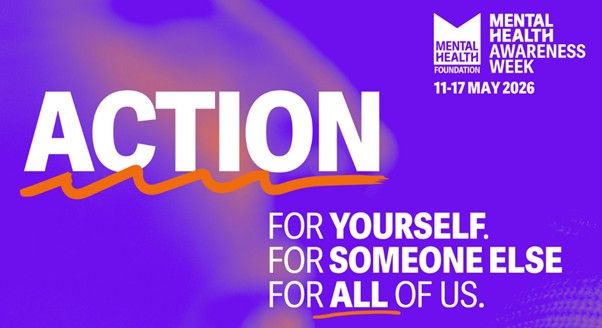
Mental Health Awareness Week 2026 Action theme poster. Source: mentalhealth.org.uk
When speaking with students during our mental health events last year, a striking pattern emerged. Many could articulate why mental health matters. They understood the importance of balance, self-care and support. But what they struggled with, however, was far more practical: what does looking after your mental health actually look like in day-to-day life? Where do you begin? What actions genuinely help?
This is why the theme for this year’s Mental Health Awareness Week, taking place between 11-17 May 2026, is perfect for addressing this gap between understanding and application. The theme is “action” because, as the Mental Health Foundation put it, “whilst awareness is vital, real change comes when we take action”.
What Does “Action” Mean?
Awareness campaigns have played a vital role in challenging outdated attitudes and normalising conversations around mental health. But awareness alone does not always translate into confidence or behaviour. Action, therefore, becomes the missing link. Action does not have to be dramatic or transformative overnight. In fact, the most effective actions are often the simplest and most sustainable. They are the habits and reflections that gradually build resilience over time.
For students, this might mean:
- recognising early signs of stress rather than waiting for a crisis
- creating a routine that supports both productivity and rest
- reframing help-seeking as strength and not failure
- understanding that wellbeing fluctuates – and that this is normal.
Furthermore, action looks different for everyone. There is no universal formula for mental wellbeing so comparison can often do more harm than good. Empowerment comes from helping individuals identify what works for them.
Alongside student action, the role of staff remains fundamental. At FSB, staff are not only facilitators of learning but contributors to a culture of care and psychological safety. Through everyday interactions, staff are often well placed to notice early changes in student behaviour, offer reassurance and guide students towards appropriate support. Creating an environment where students feel seen, heard and able to speak up openly is essential to ensure conversations around mental health translate into meaningful action.
What is FSB going to do for Mental Health Awareness Week?
To promote the idea of taking action, FSB is developing a “Mental Health Awareness Week and Action” workshop and activities to encourage students to ask meaningful questions of themselves: What makes me feel good? What challenges do I have? What support do I need — and how do I access it? These are questions that remain relevant far beyond FSB life.
We will get students to explore the ways that they currently experience stress, what stops them from taking action, and how they can take small steps to prioritise their wellbeing and seek to restore balance in their lives. We will also explore the connection between physical and mental health, the power of connecting with others, and the importance of hobbies and creativity.
From previous discussions with students, lack of time was a common factor they cited for limiting the action they took to look after themselves. We appreciate that our students are busy with their studies whilst juggling work and family commitments. We will help students see that small amounts of time can have a big impact on their lives.
Just 10 minutes a day, or an hour a week to focus on themselves, can provide an enormous and much needed boost. Wellbeing has a massive impact on productivity and our ability to support other people. Therefore, it is counterproductive to think that we can continue without providing our brains and bodies with the break they need. We can’t give energy to our work, studies, or other people, if we don’t look after ourselves first. Therefore, we need to ensure that we continuously build our reserves to cope with the challenges of day-to-day life.
The FSB Community and Beyond
The Mental Health Foundation’s call for action includes “action for yourself, action for someone else, and action for all of us”. Therefore, FSB will be encouraging students to take action to empower themselves, to help each other, and to support the FSB community.
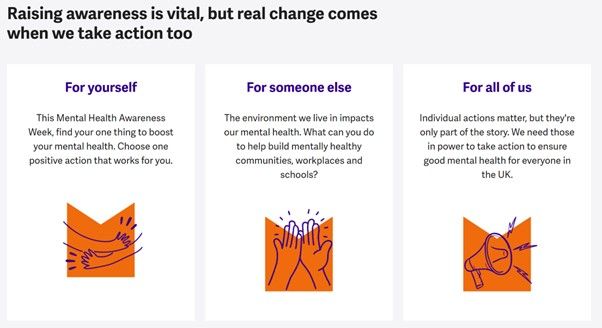
Source: mentalhealth.org.uk
This builds on previous themes at FSB events and recent training for all staff and students on the importance of healthy relationships and a healthy community at FSB. In a world where there seems to be increasing hostility between people with different backgrounds and personal identities, we must take a moment to reflect on how we look after each other. As this year’s theme implies, looking out for someone else not only benefits them but provides a boost to our own mental wellbeing.
Therefore, we encourage all students to participate, and if you are a staff member and want to support our endeavours, then we would love for you to get involved too. Let us embody the Mental Health Foundation’s message that “when we come together, we are even more powerful”.
Look out for pictures of the MHAW events on our usual FSB social media channels.
Beyond a Single Week
Ultimately, action for FSB students is not about perfection, nor is it about achieving a faultless version of wellbeing. Rather, it is about consistency, self-awareness and confidence to respond to life’s pressures with intention – rather than just reaction. Mental wellbeing is not a peripheral concern; it is the very foundation upon which academic success, professional progression and personal fulfilment are built.
Choosing to prioritise one’s mental health is a powerful and deliberate act. By embedding small, sustainable practices into everyday life, students can begin to transform wellbeing from an abstract concept into a lived experience.
With the demands of modern life showing little sign of slowing down, creating space for reflection and restoration is no longer optional – it is essential. While one week cannot redefine a lifetime of habits, it can serve as a catalyst. It can prompt a pause, and, most importantly, initiate action. And action, however modest, is where meaningful change begins.
Where to go for support
If you are a student at FSB and are struggling with your mental health, then please reach out to the Student Support and Welfare Services, who will put you in touch with one of our specialist staff or assist with referring you to a local organisation or charity to support you.
If you are facing a mental health crisis, then the following organisations provide crisis support:
| Organisation | About |
|---|---|

NHS – A&E Website: Find your local NHS A&E service Telephone: 999 |
Where there is an immediate risk of harm to self or to life please go to A&E or call 999.
You can find your local A&E through the link to the left. |
|
NHS – Urgent Care Website: NHS urgent mental health help Telephone: 111 |
When help is urgent, call NHS 111 and select the mental health option. |

Samaritans Website: Samaritans website Email: jo@samaritans.org Telephone: 0114 276 7277 or 116 123 |
The Samaritans is a national charity who run a crisis hotline. |

SANEline Website: SANEline services Telephone: 0300 304 7000 |
Mental Health Phone line open 4.30pm–10pm every day. |

Suicide Prevention UK Website: National suicide prevention helpline Telephone: 0800 587 0800 |
Suicide / urgent support helpline open 6pm–midnight every day. |
Shout 85258 Text: SHOUT to 85258 |
Immediate, confidential, 24/7 text support for anxiety, stress, depression, loneliness or suicidal thoughts. |
References
Mental Health Foundation (2026) Mental Health Awareness Week 2026. Available at: https://www.mentalhealth.org.uk/our-work/public-engagement/mental-health-awareness-week (Accessed: 28 April 2026).