By Kunal Chan Mehta, PR Manager and Editor, FSB and Ali Dawn, Student Life Cycle and Enhancement Manager, FSB Article Date | 07 October 2026
This article discusses issues relating to mental health. If you have been affected by any of the topics covered, please seek support from a trusted professional or contact Samaritans at 116 123 (UK) or www.samaritans.org.
Progress in improving the mental health outcomes of students in higher education requires continuous evaluation of services and underpinning strategy. This World Mental Health Day 2026, Fairfield School of Business reflects on this year’s global message: real change happens when we fully utilise lived experience as a powerful tool to shape provision, beyond the standard feedback mechanisms, and start to see students as partners in the creation of impactful services.
This year’s World Federation for Mental Health (WFMH) theme, “Lived experiences heard: real voices, real change“, challenges a long-established hierarchy of expertise. In mental health services, the authority for designing provision usually rests predominantly on the valuable knowledge and expertise of doctors, psychologists, researchers and policymakers. The “service user” has historically been treated merely as the recipient of that expertise rather than being empowered to be a partner in the co-creation of their recovery journey.
Professional expertise in clinical care, academic research, and policy design is essential. Yet, none of these perspectives can capture what it actually feels like to navigate support systems on a daily basis. Lived insight reveals what is easily overlooked from the outside – exposing where a service succeeds, where it breaks down and why a process that looks flawless on paper can feel unworkable in real life.
Too often, we talk about people’s experiences without giving enough space to the people who have lived them. While institutions routinely design services, draft policies and track metrics centred around individuals, a fundamental question remains: how often do those same individuals hold genuine decision-making power in shaping them?
The World Health Organisation (WHO) recognises lived experience as a vital form of expertise, noting that it can provide knowledge that professional training and research alone cannot. Further, lived experience is sometimes treated as a powerful story to be shared before the professionals return to making the decisions. It should be more than that.
Academic research mirrors this institutional shift. As Hawke et al. (2023) highlight, people with lived experience contribute experiential expertise that should be valued alongside empirical research. Crucially, lived experience does not replace professional expertise – it helps complete the bigger picture.
Is Listening Enough?
There is a world of difference between recording someone’s experience and letting them help fix the problem. Asking what went wrong merely archives the past; asking what needs to change gives people a direct hand in shaping the future.
The WHO’s figures illustrate this gap clearly:
- 80% of countries with a mental health policy reported consulting people with lived experience during the policy’s development.
- Only 45% reported ongoing collaboration in planning, delivering or monitoring mental health services.
- Just 37% involved people with lived experience in mental health training for primary healthcare workers.
Good listening goes beyond asking for feedback. Students are far more likely to engage when they can see that what they say has been heard and translated into meaningful change. After all, the real value of consultation lies not in how many responses we collect but rather in what we do with them. As the Mental Health Foundation (2026b) points out, good listening means paying attention, giving someone the space to speak, and – crucially – resisting the urge to jump straight into problem-solving mode before fully understanding their experience.
This perspective matters deeply in higher education. If we are developing a wellbeing initiative, students should help shape it. If we are reviewing a support service, we should want to know what it was like to use it – not simply how many people used it.
Lived Experience in Action at FSB
The approach to developing Student Support and Welfare Services at FSB has always been grounded in the real, everyday realities of our students. As an alternative provider, our students have a rich and varied history that has to be skilfully navigated and understood to deliver impactful interventions. By prioritising direct conversations over assumptions, we work alongside students to understand their individual journeys and deliver support that actually fits.
This approach echoes FSB’s Teaching and Learning Strategy. The life experiences our students bring into the classroom are among our greatest strengths. They offer real-world perspectives that standard textbooks cannot capture, enriching academic discussions while also directly influencing how we act.
However, opening space for real voices also means establishing firm boundaries. Single stories do not speak for everyone, nor should anyone feel expected to perform their trauma to justify institutional policy. True partnership guarantees that participation is always voluntary, secure and thoughtfully supported.
Listening to lived experience fundamentally changes how an institution operates. Instead of relying on rigid, top-down policies, support services adapt to how people navigate them – turning students into active partners in building a better campus.
This World Mental Health Day 2026, the principle is straightforward: if people choose to share their experience, the knowledge within it should be taken seriously. So, perhaps the real point is not whether we listened. It is whether anything positively changed because we did.
Putting these principles into practice begins right here on our campuses – turning global dialogue into tangible community action.
Of course, integrating student voice into policies and procedures is only one part of the picture. True support is also about everyday connection. That is why, alongside our interactive workshops exploring what it means to be truly heard, we are bringing back our popular ‘Tea & Talk’ initiative across our common rooms. Students and staff are invited to grab a free hot drink, take a breather, and open up safe spaces for conversation—because sometimes, the most vital part of being heard is simply knowing someone is there to listen.
Get Involved Across FSB Campuses
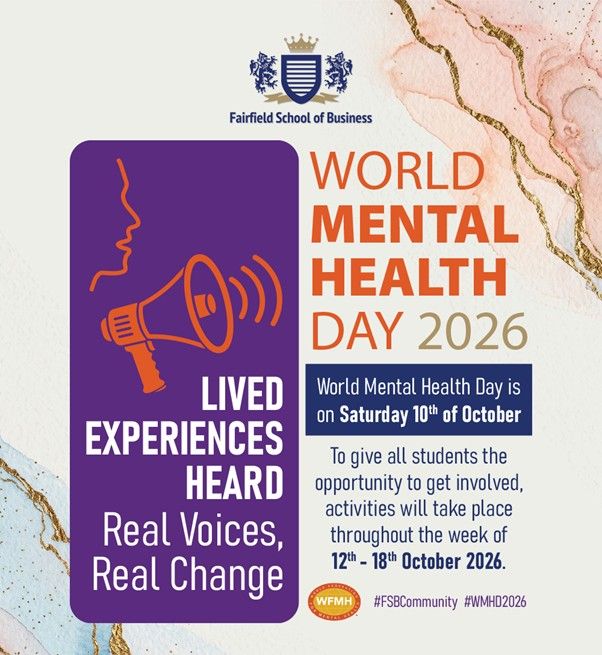
While World Mental Health Day officially takes place on Saturday 10th October 2026, FSB will be hosting a series of interactive workshops, listening sessions, and community events throughout the week of 12th–18th October 2026 across all campuses.
This World Mental Health Day, let’s make more room for listening. Because sometimes the most meaningful support begins with making someone feel heard.
Need support or want to get involved?
- Reach Out: Contact the Student Support and Welfare Services office on your campus to find out how you can participate or if you need help.
- Take Part: Visit your common room during the week of 12-18 October 2026 to take part in our “Tea & Talk” initiative and have a free cup of tea (or coffee) on us.
- Join the Conversation: Use #FSBCommunity and #WMHD2026 on FSB social media.
References
Hawke, L.D., Sheikhan, N.Y. and Rockburne, F. (2023) ‘Lived experience engagement in mental health research: Recommendations for a terminology shift’, Health Expectations, 26(4), pp. 1381–1383. doi: 10.1111/hex.13775. (Accessed: 3 October 2026).
Mental Health Foundation. (2026a) World Mental Health Day. Available at: https://www.mentalhealth.org.uk/our-work/campaigns/world-mental-health-day (Accessed: 3 October 2026).
Mental Health Foundation. (2026b) How good listening skills can support someone’s mental health and wellbeing. Available at: https://www.mentalhealth.org.uk/explore-mental-health/blogs/how-good-listening-skills-can-support-someones-mental-health-and-wellbeing (Accessed: 3 October 2026).
University of Oxford. (2023) World Mental Health Day 2023: Supporting student mental health at Oxford. Available at: https://www.ox.ac.uk/students/news/2023-10-10-world-mental-health-day-2023-supporting-student-mental-health-oxford (Accessed: 3 October 2026).
World Federation for Mental Health (WFMH). (2026) World Federation for Mental Health. Available at: https://wfmh.global/ (Accessed: 4 October 2026).
World Health Organisation. (2025) Transforming mental health through lived experience: roadmap for integrating lived and living experience practitioners into policy, services and community. WHO Regional Office for Europe. Available at: https://www.who.int/europe/publications/i/item/WHO-EURO-2025-12307-52079-79927 (Accessed: 4 October 2026).